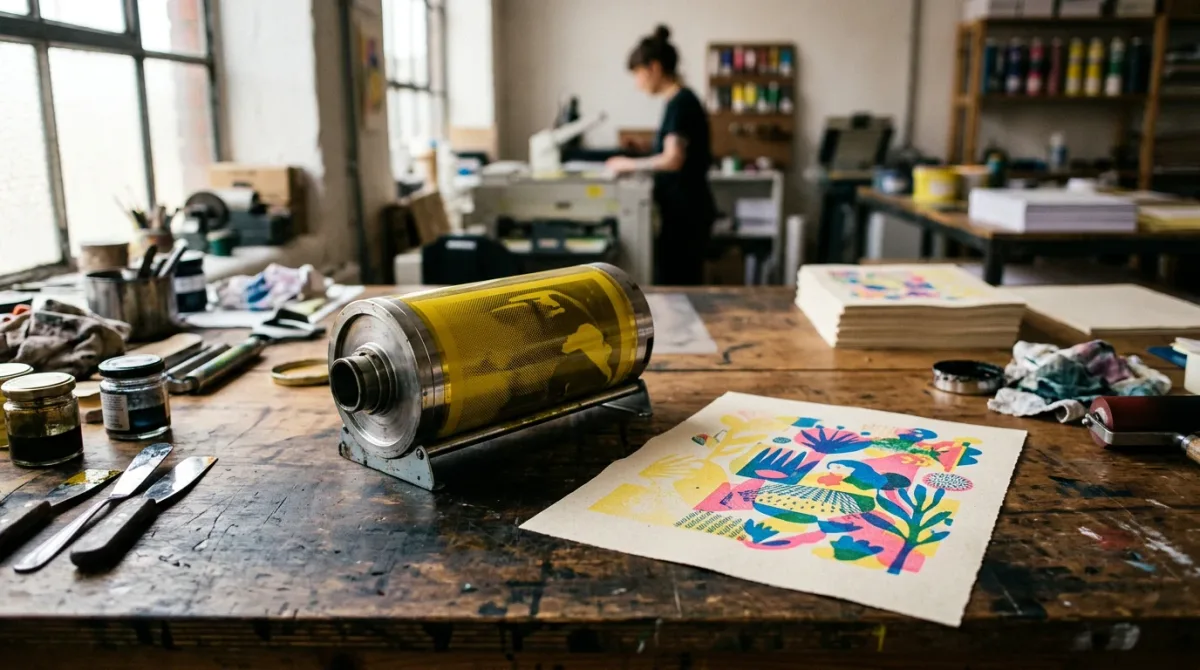
Risograph printing is a stencil-based duplicating process: a machine burns a digital design onto a thin master, wraps that master around an inked drum, and forces ink through it onto paper as the drum spins, one colour at a time. It is this layering, colour by colour, that gives risograph prints their telltale grain, their slightly-off registration, and the glowing, almost neon depth that has made the process a favourite among illustrators, zine-makers and small presses.
The word itself has an unglamorous origin: risograph machines were built as high-speed office duplicators, cousins of the mimeograph, designed to print newsletters and exam papers cheaply and fast. According to the manufacturer RISO, a master stencil is generated directly from a design file or a scanned original and wrapped around a drum; ink is then pushed through the perforations in that stencil as the drum rotates against the paper. For a single colour, that is the whole process. For more, the machine (or the operator, on older models) swaps in a new drum loaded with a different ink and a fresh master, and runs the same sheet through again, building the image in overlapping passes.
That drum-and-master mechanism is also why risograph colour is so particular. Because each colour is a separate physical pass rather than a blend calculated on the fly, as with an inkjet or laser printer, risograph printing can't mix custom colours the way CMYK printing does; instead, RISO produces the machines with a fixed palette of interchangeable ink drums. RISO's own literature lists 21 standard colours available as colour-matched drums, alongside specialty options including fluorescent shades and a metallic gold, and notes that overlapping two of those flat colours is what produces the layered, unpredictable gradients associated with the technique. RISO's twin-colour duplicator, the MH9350, prints two of those colours in a single pass at up to 150 pages a minute at 600 dpi on paper up to A3, while single-colour models such as the SF9390 run faster still, at up to 190 pages a minute.
The ink itself is part of what separates risograph output from a standard print run. RISO describes its inks as emulsion-based and made from sustainable raw ingredients such as soy oil or rice-bran oil rather than petroleum, which is part of why the results dry into paper rather than sitting glossy on top of it — risograph printing works best on uncoated stock, which soaks the ink in and gives the finished sheet its slightly matte, fabric-like texture. RISO markets the rice-bran-oil formulation used in machines like the MH9350 as VOC-free, a detail that has made risograph printing attractive to small studios working in shared spaces without industrial ventilation.
Modern risograph duplicators also build the master three ways: by scanning a physical original on an integrated scanner, by printing directly from a computer through the machine's internal controller, or, on newer models, from a tablet app that handles colour separation for the operator before the file ever reaches the drum. That last step — separating a full-colour illustration into individual flat-colour layers, one per drum pass — is the part of the process illustrators spend the most time learning, because it is where the deliberate misregistration and colour-bleed that define the risograph look actually get designed in, rather than simply happening by accident.
Why do risograph prints look grainy and slightly misaligned?
Because each colour is printed as a separate pass through the drum and master system, tiny shifts in paper alignment between passes are common, and the ink itself sits unevenly on absorbent, uncoated paper — together, those two factors produce the soft grain, visible texture and gentle colour drift that read as "risograph" rather than as a printing fault.
Why can't a risograph print just any colour?
Risograph duplicators use physical, colour-matched ink drums rather than a mixable ink reservoir, so a machine only prints the finite set of colours it has drums for; RISO lists 21 standard colours plus specialty inks such as fluorescents and metallic gold, and any other shade has to be approximated by layering two of those flat colours on top of each other.
Small studios have built entire practices around those constraints rather than working around them. Gabriella Marcella founded her Glasgow studio Risotto in 2012 after falling for risograph printing, starting out with a secondhand machine run from her own bedroom before the studio found its current home at the Glue Factory, a converted warehouse shared with other creative practices. In 2017 she launched the Riso Club, a subscription mailing four postcards by four different artists to subscribers every month; the project recently marked its hundredth mailing with a retrospective show of all four hundred commissioned artworks. Of building a project around the postal service's own unhurried pace, Gabriella Marcella wrote that "having something like a subscription that allows you to consume creative media on a completely different cycle, as slow as snail mail is, is really refreshing."
That appetite for a slower, more physical kind of image-making is a large part of why risograph printing, built for photocopying office memos, has instead become a fixture of independent publishing: it rewards designers who plan their colour separations by hand, and it prints beautifully on the recycled, uncoated papers zine-makers already favour. For readers who want to see the process in practice, RISO's own product pages set out the technical specifications in full, and small risograph studios and printmakers across the UK continue to run public workshops where the drum, the master and the ink can be seen turning a design into a print, one colour at a time.
For a related illustration perspective, read How Does Watercolour Granulation Work?.
For more context, read How Risograph Printing Layers One Vivid Colour at a Time.