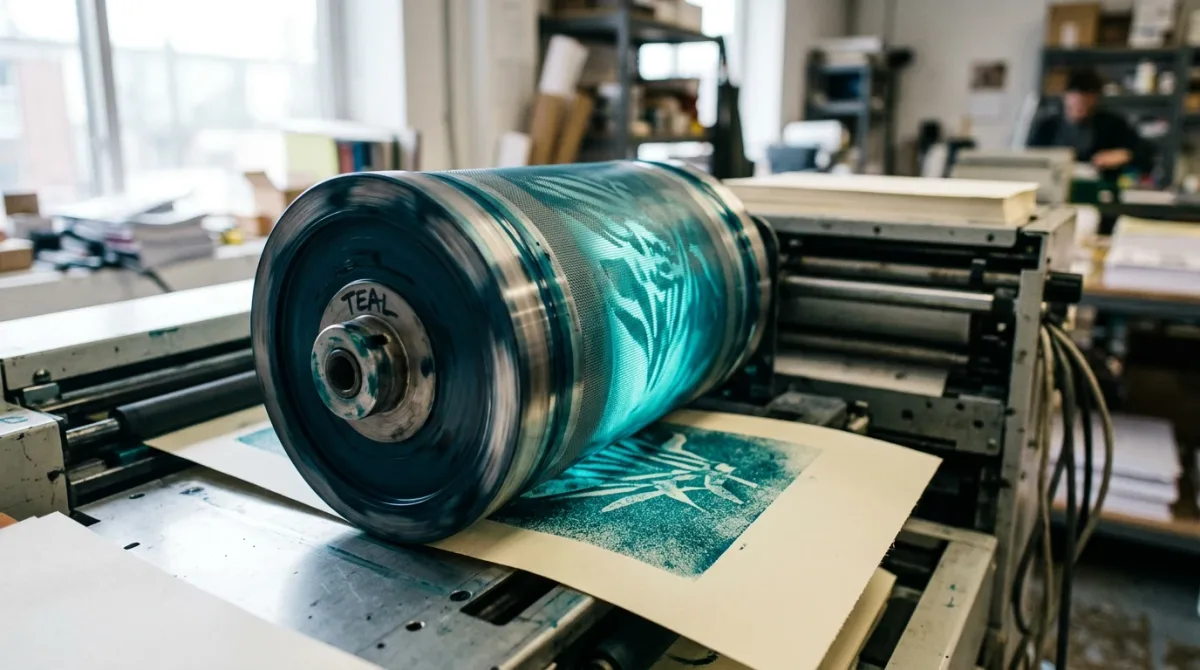
Risograph printing is a stencil-based duplicating process that pushes thick, vivid ink through a fine mesh stencil wrapped around a rotating drum, printing one flat colour at a time onto paper fed beneath it. Often described as sitting somewhere between screen printing and photocopying, the machine was developed by Japan's Riso Kagaku Corporation, and it has become a favourite low-cost, hands-on method for illustrators, zine-makers and small presses producing short runs of bold, slightly imperfect prints.
Where Did the Risograph Come From?
The risograph traces back to September 1946, when its founder, Noboru Hayama, began a mimeograph printing service in Tokyo under the business name RISO-SHA, according to the company's own history pages. RISO INK, an emulsion ink, followed in 1954, then a dedicated RISO-GRAPH mimeograph device in December 1958. The company was incorporated in January 1955 and took the name Riso Kagaku Corporation in January 1963. Through the 1960s and 1970s it moved from thermal stencil devices into xerographic equipment, a slow evolution from office duplicating service to the compact drum-based printers that print studios use today.
How Does a Risograph Actually Print an Image?
A risograph prints by burning a stencil, wrapping it around an ink-filled drum, and pressing paper against it as the drum spins. According to Reed College's guide to its print lab, artwork reaches the machine either as a digital file sent from a computer or as an original scanned on the machine's own scanner bed. From there, the process runs in a fixed sequence.
- The operator chooses ink colours and loads paper into the machine.
- The risograph creates a stencil, called a "master," from the artwork; as MIT's PPPPress guide puts it, "the RISO printer squeezes ink through the mesh of the generated screen onto the page," with the image data clogging specific holes in the mesh to control where ink can pass.
- That master is wrapped around the machine's ink drum, one drum per colour.
- Paper is fed beneath the drum, and as it rotates, ink is pressed through the master and onto the page.
- For a design with more than one colour, the sheet is run through again with a different drum and a different master, built from a separate colour separation prepared for that ink.
Because each master is discarded after its print run, no two risograph editions are struck from the exact same stencil twice.
Why Does a Risograph Only Print One Colour at a Time?
A risograph prints one colour at a time because each drum carries a single ink and a single master, rather than mixing colours the way a laser or inkjet printer does. MIT's guide notes that its own machine works with only four inks — black, blue, yellow and red — which is not the CMYK set used in conventional colour printing, making true colour blending "very difficult." To build a multicolour image, an illustrator has to prepare individual colour separations in advance, then send the paper through the machine once per colour, trusting the drums to land in roughly the same place each pass.
What Makes Riso Ink Different From Ordinary Printer Ink?
Risograph ink behaves nothing like the ink in a home printer. The University of Illinois's guide to its riso lab describes the ink as rice oil-based and free of drying agents, which means it never fully cures on the page; prints can smudge with handling much like newsprint, and a spray fixative is recommended for anything that will be touched often. Reed College's guide calls riso inks "unprocessed," noting that this lets printers manipulate saturation and mix ink colours to create new ones on the fly, rather than relying on a fixed palette.
Why Do Illustrators Love a Print That Doesn't Quite Line Up?
For many makers, the risograph's quirks are the whole point. Sarula Bao of Endless Editions told Hyperallergic that the machine's constraints push artists further rather than holding them back: "Within the limitations of riso, artists can actually explore further. And even within the control that they have, the image is still always going to come out a little wonky. There's always going to be imperfections and mis-registrations. Which is part of riso's magic." Marc Fischer of Half Letter Press, who told Hyperallergic he has printed more than a million riso copies over the years, pointed to speed as much as texture — he printed and distributed a zine the same day during the pandemic — and to the ink's low cost compared with offset runs of similar size. Both printers also spoke of the shared knowledge that builds up around the machines: Fischer described trading notes on papers and inks with other riso users regardless of what each was printing, a community as much bound by the equipment as by any single style.
That mix of affordability, speed and cheerful unpredictability is why so many print studios and university labs, from Reed College to MIT, now keep a risograph running for illustrators and students alike — a fifty-year-old office duplicator turned into one of the most distinctive presses in independent publishing.
Frequently Asked Questions
Can a risograph print full-colour images like a home printer?
Not directly. A risograph applies one flat ink colour per pass from a dedicated drum, so a multicolour image needs a separate colour separation and a separate pass through the machine for each ink, rather than blending colours the way a laser or inkjet printer does.
Does riso ink dry the way ordinary printing ink does?
No. Risograph ink is rice oil-based and contains no drying agent, so it never fully cures on the page; the University of Illinois's print lab guide notes it can smudge like newsprint and recommends a spray fixative for prints that will be handled often.
Why do riso prints often look slightly misaligned between colours?
Each colour is printed from its own drum and master in a separate pass, so slight shifts between passes are built into the process. Printers like Sarula Bao of Endless Editions consider that misregistration part of the technique's appeal rather than a flaw to eliminate.
For a related design perspective, read How Does Risograph Printing Actually Work?.
For more context, read How Does Risograph Printing Actually Work?.
For more context, read How Risograph Printing Layers One Vivid Colour at a Time.