Every maker who ships work eventually does the same arithmetic: the cost of one broken platter — refund, replacement making-time, apology — against ten minutes and a few pounds of extra packing. Parcels are handled at speed, sorted by machine and stacked by weight, whatever the fragile tape says. The good news is that the practices which reliably cut breakage are known, cheap and slightly tedious, which is exactly why they work. This is the packing method used across working studios, for ceramics first and works on paper second.
How do you pack ceramics so they survive?
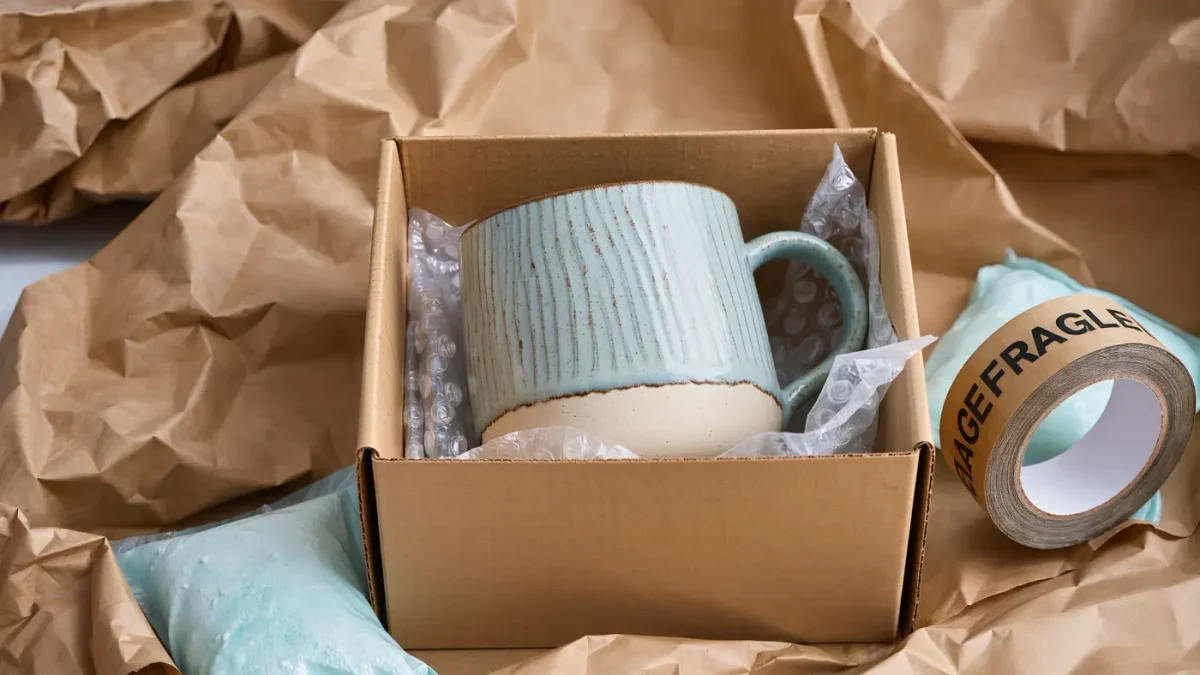
Double-boxing is the non-negotiable core. The piece is wrapped individually — each cup, each lid, each handle wrapped on its own in bubble wrap or tissue and taped — then packed inside a smaller inner box with cushioning material on all sides, roughly five centimetres of it. That inner box then floats inside a larger outer box on another five centimetres of cushioning, so no part of the work can touch an outer wall. Void fill — screwed-up kraft paper, air pillows — immobilises everything; the shake test is universal: if it rattles, it breaks.
Two rules finish the method. Heavy items go in smaller boxes, because a 15-kilogram box of mugs is dropped, not carried. And pairs are separated: a bowl nested inside a bowl needs a layer between them, or the journey does the trimming for you.
Related stories: Selling Print Editions: How Numbering, Sizes and Prices Hold Hands · How to Price Handmade Work Without Underpaying Yourself.
How should prints and works on paper travel?
Flat is safest for small works: print sandwiched between two stiff boards slightly larger than the sheet, then in a board-backed envelope marked do not bend. Larger editions travel rolled around a generous diameter — a wider roll means gentler curvature — inside a rigid tube with tissue protecting the printed surface, and flanges or end-padding stopping the work from shifting. Never roll thickly applied or fragile media; pastel and charcoal surfaces prefer flat travel with glassine interleaving, a convention print shops have held for decades.
What about compensation when it still goes wrong?
Carrier compensation schemes exist but pay out only within their published limits and claiming requires evidence — photographs, receipts, proof of posting — which is why studios photograph every finished piece and its packed box before dispatch, a habit consumer postal guidance on GOV.UK frames from the buyer's side. Insurance for higher-value work is sold separately and priced on declared value; read the exclusions, because packing to the carrier's own stated standard is usually a condition of the payout. And a broken-piece policy, stated plainly on your shop page — replacement or refund, and how quickly — costs nothing and buys more customer goodwill than any claim form.
The last practice is the quietest: keep a breakage log. Studios that note what broke and how it was packed stop repeating the same loss, and after a season the log, not folklore, sets the packing standard for every new shape that leaves the bench.